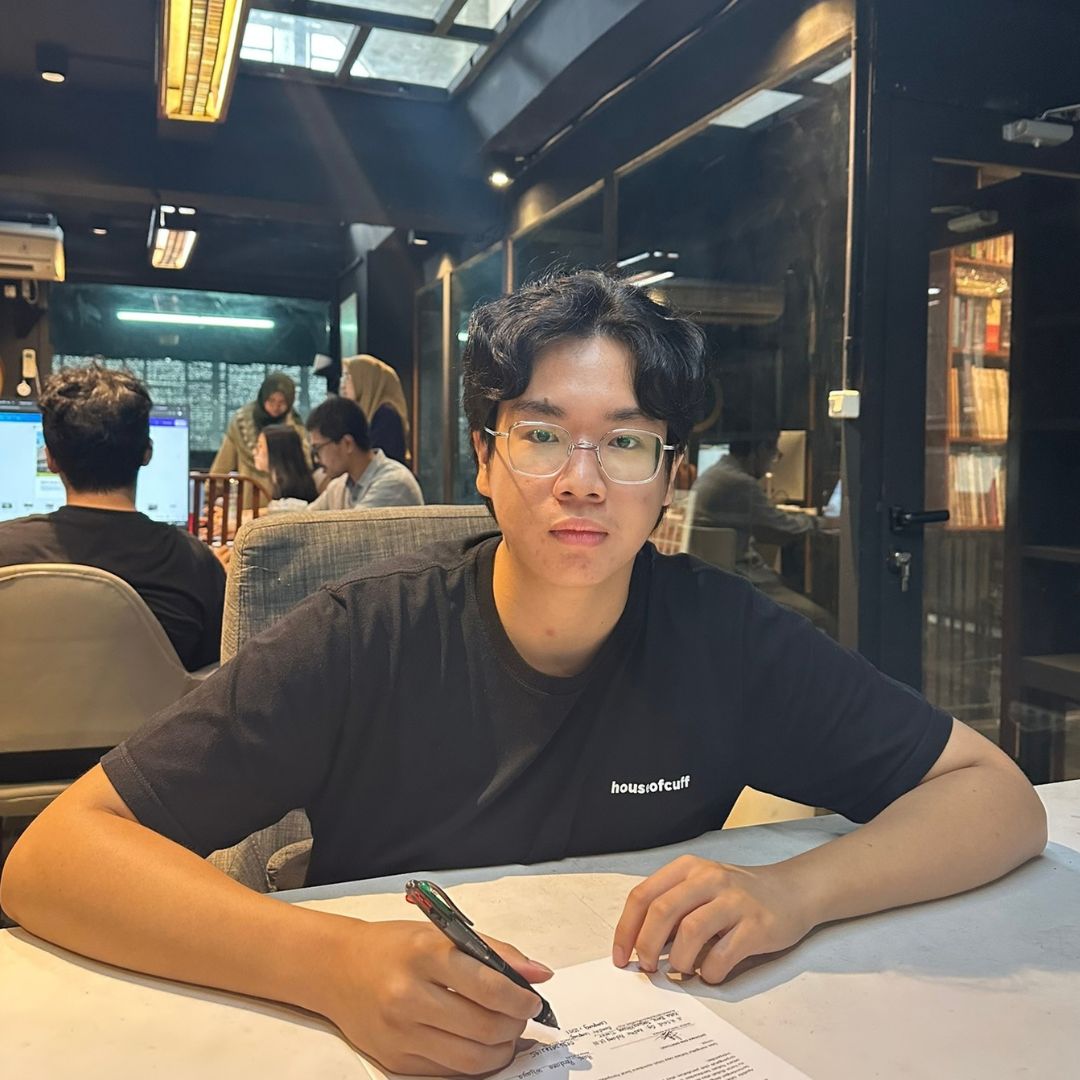
June 2026, I entered Realrich Architecture Workshop with a set of ideas about architecture that were still developing. I leave with many of them still unresolved, but I think this is probably the most honest result I could have hoped for from an internship. I did not expect four months in an architecture office to give me a final definition of what architecture should be. Instead, it made some of my questions sharper and made me more aware of the distance between the way I think about architecture and the way architecture is often practiced.
My path into architecture was not direct. Before studying architecture, I studied biotechnology. I eventually left because of circumstances related to my scholarship, not because I had lost interest in the field. However, the way I learned to think there stayed with me. Biotechnology taught me to be comfortable with evidence, testing, variables, and uncertainty. Even when a problem was complex, there was an expectation that a claim should have some relationship with evidence.
When I entered architecture, I was attracted to its possibility of combining technical reasoning with human experience. At the same time, I was surprised by how difficult it was to determine whether an architectural statement was actually true. In architecture, the word “theory” can describe many different things. Sometimes it describes an observed behavior. Sometimes it proposes a causal relationship. Sometimes it expresses a value or interpretation. Sometimes it is simply a way of explaining a design decision. These are not the same kinds of claims, yet they can often be discussed with similar confidence.
This became one of my main questions: how do I know that an architectural idea is actually useful, rather than merely convincing?
My answer has gradually become more practical. I want to begin with what can be understood, tested, and argued clearly. I am most comfortable with structure, climate, light, water, material, circulation, and other conditions that architecture can directly affect. I like the idea that a building should first be made to work, and only after that should questions of visual expression become more prominent. I do not mean that beauty is unimportant. I simply do not want beauty to become the starting point that forces the rest of the building to follow.
This position has also made me skeptical of the tendency to give architecture responsibility for every social problem. I often hear arguments that architecture can solve loneliness, create community, or transform society. I believe architecture can contribute to these things, but I think the distinction matters. A public space can create opportunities for encounter. A housing project can make social interaction easier. A school can affect how people meet and move. But loneliness is also shaped by relationships, personality, social networks, economic conditions, culture, and many other factors that a building cannot control.
For me, good architectural thinking does not require architecture to claim more power than it actually has. The closer a problem is to something the building directly changes, the stronger the architectural influence usually is. A facade can change heat gain. A roof can influence rainwater. A plan can affect visibility and circulation. A public space can make lingering easier or harder. But when we move toward larger social outcomes, architecture becomes one factor among many. This does not make architecture less meaningful. It simply makes the claim more honest.
My philosophical interests have influenced how I approach this problem. Aristotle has made me interested in practical judgment and the difficulty of making good decisions when there is no perfect rule. From his idea of intellectual virtue, I learned there are many types of virtues to apprehend the truth, whether it is universal truth or practical wisdom. Architecture rarely provides a situation where one principle can solve everything. There are always competing requirements, and the architect has to decide what is appropriate to the particular situation. The role naming in RAW actually quite surprised me because of this concept.
Nietzsche has influenced me in a different way. From his book The Birth of Tragedy, I am interested in his distinction between the Apollonian and Dionysian tendencies, especially because I recognize the tension between them in myself. I naturally lean toward the Apollonian side: order, structure, reasoning, clarity, and control. These qualities are useful to me in architecture, but I have also realized that I sometimes use rationality as a way to avoid uncertainty. I want every decision to have a reason that I can explain. I become uncomfortable when something exists simply because it feels right.
The difficulty is that architecture is not only a problem of explanation. There is also intuition, atmosphere, emotion, beauty, and experience. I have found it difficult to allow this Dionysian part of myself to participate without immediately trying to justify it. Even when I enjoy something aesthetically, I sometimes feel the need to find a deeper reason for why I enjoy it. This is something I am still learning to accept. Perhaps not every subjective experience needs to become an objective argument.
Camus gives me another important correction. I naturally want things to have meaning. I want to know why a form exists, why a system is organized in a certain way, and what larger idea the building is expressing. But there is a danger in this habit. Sometimes I can search for meaning long after the evidence has ended. Camus reminds me that the absence of a final meaning does not necessarily have to be a problem that I solve. Not every architectural decision needs a grand philosophical justification. Sometimes something is simply the result of a constraint, a preference, an uncertainty, or a compromise. I am learning that this does not necessarily make it less valuable.
Christopher Alexander has also been important to me because some of the reasoning in A Pattern Language feels surprisingly close to how I naturally think. I appreciate his attempt to connect recurring conditions with spatial solutions rather than treating architecture as pure artistic expression. At the same time, I do not want to accept patterns as universal truths without questioning their limits. For me, Alexander is more valuable as a methodological challenge: can recurring relationships between environment, behavior, and experience be identified and tested rather than simply believed?
My interest in Peter Zumthor and Juhani Pallasmaa has also helped me understand the part of architecture that my rational side tends to neglect. Their emphasis on atmosphere, material, touch, sound, memory, and bodily experience reminds me that architecture is experienced by people rather than evaluated only through diagrams and performance criteria. I do not want to abandon my analytical approach because of this. Instead, I want to find a way for rationality and experience to coexist.
These ideas also shaped how I experienced my four months at RAW. What I value most about RAW is its serious attention to environmental conditions. Wind, water, plants, sunlight, material, and the relationship between buildings and their surroundings are treated as actual design considerations. This is close to the kind of architecture I want to learn from: architecture that responds to things that physically exist.
I also appreciate the intellectual ambition of the office. RAW is willing to discuss architecture beyond drawings and construction details, and I value being in an environment where architectural ideas are taken seriously.
My experience at RAW showed me how difficult it is to connect conceptual thinking with technical development. Architecture requires many kinds of knowledge to meet at the same time. An idea that seems strong conceptually can create technical problems when it reaches development, while a technical limitation can require the concept to change. When many people are involved in different stages of the process, this can create repeated back-and-forth, especially under tight deadlines.
I do not see this as a simple failure of the design process. It is partly the nature of architecture. No single person can be equally specialized in every aspect of a building. What I learned is that intellectual ambition needs a strong relationship with technical understanding. A beautiful concept that cannot be developed is incomplete, but a technically correct solution without spatial intention can also become limited. The challenge is to make the two inform each other as early as possible.
The internship also changed how I understand criticism. I used to feel that every decision needed to be defended because I had a reason for making it. I now realize that having a reason does not mean that the decision is complete. Criticism can reveal an incomplete assumption without necessarily proving the original idea wrong. I am trying to become harder to convince, but easier to inform: listen, understand what is being questioned, test it, and then respond.
After four months at RAW, I do not leave with a finished theory of architecture. I leave with a clearer way of asking questions. I want to ask what a building can actually change, what evidence supports a claim, which parts of a decision are objective and which are judgment, and whether a concept produces real consequences in space, environment, structure, or experience.
I also leave with a greater respect for the difficulty of practice. Architecture is not only the moment when an idea becomes a drawing. It is coordination, negotiation, revision, technical limitations, people, time, money, and responsibility. My internship made that reality more visible to me.
I began architecture after biotechnology thinking that perhaps I had simply moved from one way of solving problems to another. I now think the relationship is more complicated. Biotechnology taught me to ask how I know something. Architecture has taught me that sometimes the answer is not measurement alone. It can also be judgment, experience, context, history, culture, or interpretation. My task is not to force everything into one system of knowledge, but to understand which kind of reasoning is appropriate for which kind of problem.
That is what I want to carry forward from these four months. I want to make architecture that is practical without becoming indifferent, intellectual without becoming unnecessarily abstract, expressive without exaggerating its claims, and beautiful without making beauty the only reason it exists. I do not know exactly what kind of architect that will make me. After four months, I think I am becoming more comfortable with that uncertainty.


